The Mason Jar Revolution: When Midwest Mothers Outspiced Louisiana
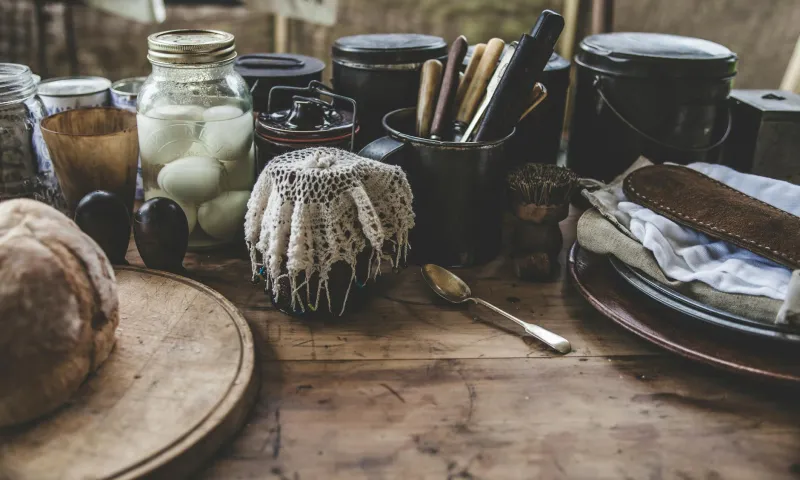
Drive through small-town Illinois today and you'll find plenty of antique shops selling dusty Mason jars, but you won't find what those jars once held: the most sophisticated hot sauces America never knew it had.
The Prairie Fire in a Jar
While food historians obsess over Louisiana's pepper legacy, they've completely missed the fermentation revolution that quietly bubbled away in Midwestern basements for nearly a century. From the 1880s through the 1950s, farm wives across the heartland were running sophisticated pepper operations that would make today's artisanal hot sauce makers weep with envy.
It started with necessity. German, Polish, and Hungarian immigrants brought pepper seeds and Old World preservation knowledge to the prairie, but they had to adapt fast. The brutal Midwest winters meant that fresh peppers were precious, and every scrap had to count. What emerged was a system of controlled fermentation that extracted maximum heat and flavor from minimal ingredients.
"My grandmother had seventeen different pepper mashes going at any given time," recalls Martha Kowalski, whose Polish great-grandmother ran a pepper operation outside Peoria in the 1920s. "Each jar had its own schedule, its own salt ratio, its own personality. She knew exactly when each one would be ready."
The Underground Network
These weren't casual kitchen experiments. By the 1920s, an entire shadow economy had developed around homemade hot sauce. Church ladies traded bottles like currency. County fair judges developed specialized palates for evaluating pepper mashes. Some operations grew large enough to supply entire townships.
The system worked because it had to. Store-bought condiments were expensive luxuries for most farm families, but peppers were cheap to grow and fermentation required no special equipment beyond what every household already owned. A successful pepper woman could trade her bottles for everything from fresh eggs to farm labor.
What made these sauces special wasn't just the fermentation — it was the regional terroir. Illinois prairie soil produced different pepper flavors than Wisconsin clay or Iowa loam. Local water sources affected the fermentation. Even the specific strains of wild yeasts floating around different farmyards created unique flavor profiles.
The Science They Never Knew They Mastered
Modern food scientists are still trying to reverse-engineer what these farm wives accomplished through pure intuition. The controlled lacto-fermentation they practiced — without knowing the term — created complex flavor compounds that industrial hot sauce production can't replicate.
They understood, through generations of trial and error, that different pepper varieties needed different treatment. They knew which combinations would develop the right acidity to prevent spoilage. They had worked out optimal fermentation temperatures and timing that modern labs would need weeks to calculate.
"These women were biochemists who never went to school," explains Dr. Sarah Chen, a food preservation researcher at the University of Wisconsin. "They were manipulating bacterial cultures and pH levels with the same precision we use in controlled laboratory conditions."
The Great Forgetting
The end came gradually, then suddenly. Post-war prosperity meant families could afford store-bought condiments. Suburban living meant fewer basement root cellars. Most crucially, the knowledge transfer broke down as younger generations moved to cities and lost interest in "old-fashioned" food preparation.
By the 1960s, the Mason jar empires had mostly vanished. The recipes died with their creators, and America settled for the standardized heat of mass-produced hot sauces. What had once been a diverse ecosystem of regional pepper traditions collapsed into a handful of national brands.
The Quiet Revival
Today, a small network of food historians and fermentation enthusiasts are trying to piece together what was lost. They're tracking down elderly relatives, decoding cryptic recipe cards, and experimenting with heritage pepper varieties.
Some have found success. Jenny Mueller, a food blogger from Cedar Rapids, has reconstructed her German great-grandmother's pepper mash recipe and now supplies three local restaurants. "The flavor is completely different from anything you can buy," she says. "It's got this deep, earthy complexity that comes from the long fermentation."
The irony isn't lost on anyone involved in the revival: the artisanal hot sauce movement that's sweeping America's cities is basically trying to recreate what Midwest farm wives perfected a century ago. They just never thought to put it in fancy bottles or charge $15 for it.
What We Lost, What We're Finding
The Mason jar revolution represents more than just good hot sauce — it's a reminder of how much culinary sophistication existed in places nobody thought to look. While food culture celebrated the techniques of professional chefs and urban restaurants, some of America's most innovative food science was happening in farm kitchens by women whose names never made it into cookbooks.
That knowledge is mostly gone now, but every recovered recipe feels like finding buried treasure. Because sometimes the best innovations happen not in fancy test kitchens, but in basement pantries where necessity meets ingenuity — and the results ferment slowly into something extraordinary.