The Living Jar That Japanese-American Families Kept on the Counter — Until the Government Made Them Leave
The Living Jar That Japanese-American Families Kept on the Counter — Until the Government Made Them Leave
Somewhere in a farmhouse kitchen in California's Central Valley, circa 1938, there is a ceramic pot sitting on a wooden counter. It's packed with a damp, golden-brown mixture that smells faintly of beer and earth. Every morning, someone reaches into it with bare hands, turns the contents over, and tucks in a few slices of cucumber or a small daikon radish. By evening, those vegetables have transformed — pickled in hours, not weeks, by the billions of microorganisms living in the bran.
This is a nukadoko, a fermented rice bran bed, and it's one of the most quietly ingenious food preservation techniques ever developed. It's also one of the most thoroughly forgotten — at least in America — and the reason why it vanished is not a story about changing tastes or industrial efficiency. It's a story about what happens when a government forces 120,000 people to abandon their homes in 48 hours.
What Is Nukadoko, Exactly?
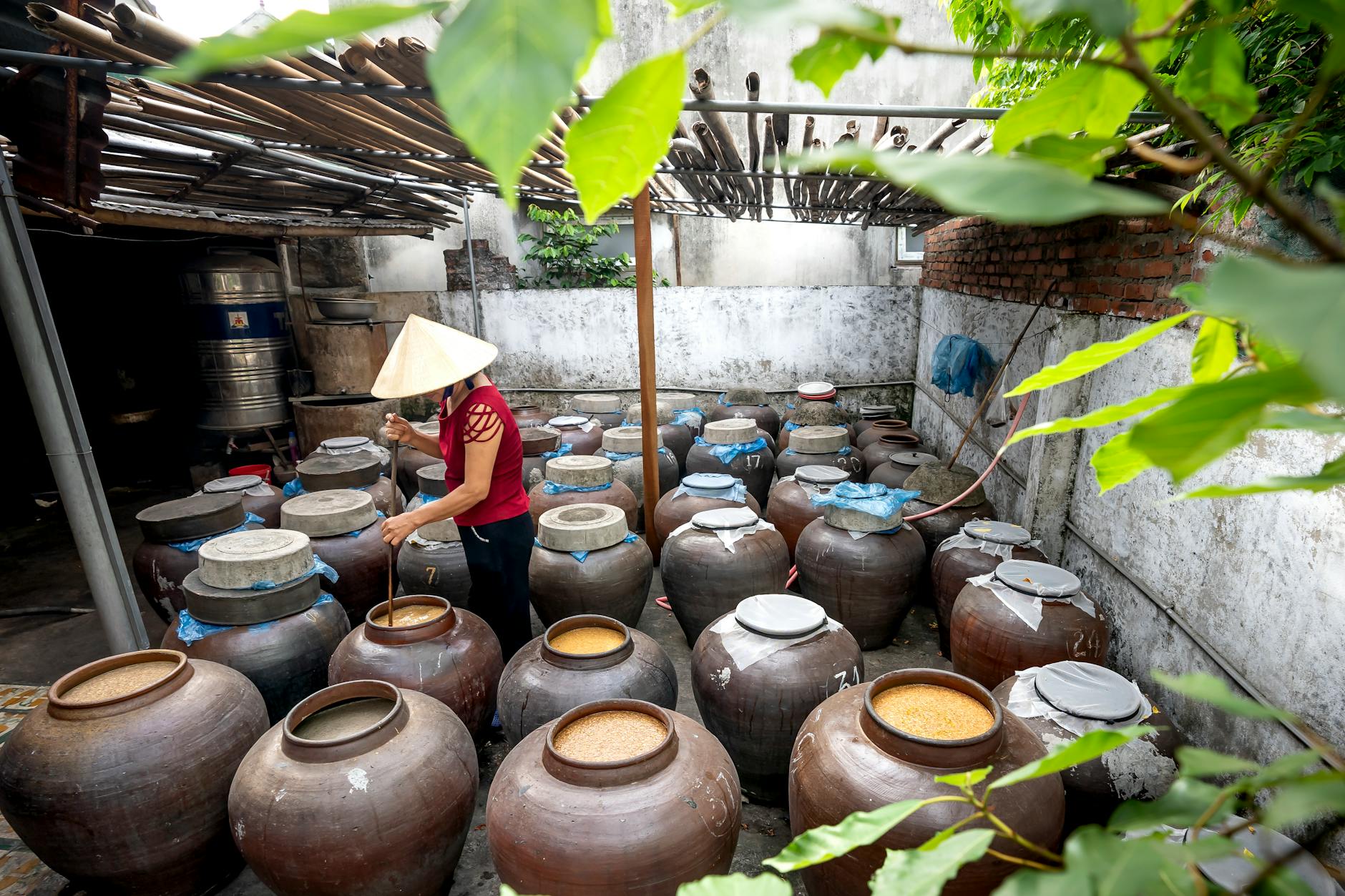
Nukadoko (pronounced noo-kah-DOH-koh) is a fermentation medium made primarily from rice bran — the outer layer removed during the milling of white rice — mixed with salt, water, and a starter culture, often a small amount of an existing nukadoko passed down through generations. The mixture is packed into a crock or wooden box and left to ferment, developing a complex ecosystem of lactobacillus bacteria, wild yeasts, and other microorganisms.
Vegetables buried in the bed — cucumbers, carrots, eggplant, turnips, cabbage — absorb salt, probiotics, and flavor compounds in a matter of hours. The result is nukazuke, rice bran pickles: crunchy, tangy, subtly funky, and genuinely unlike any Western pickle you've ever eaten. The bran bed itself can live for years, even decades, if tended carefully. Some family nukadoko in Japan are reportedly over a century old, passed down like heirlooms.
The technique dates back at least to the Edo period in Japan (1603–1868), when rice bran became widely available as white rice consumption increased. It was practical, economical, and required no special equipment — just bran, salt, and daily attention.
A Kitchen Tradition That Crossed the Pacific
When Japanese immigrants began arriving on the US West Coast in significant numbers in the late 1800s and early 1900s, they brought their food culture with them. In the farming communities of California, Oregon, and Washington — places like the Sacramento Delta, the Salinas Valley, and the agricultural corridors around Los Angeles — Japanese-American households maintained many of their culinary traditions, including nukadoko.
For Issei (first-generation immigrants) and their Nisei children, the fermentation crock was a piece of home. It was practical — fresh vegetables pickled quickly and safely without refrigeration — but it was also deeply cultural. The daily act of tending the bed, adding vegetables, adjusting salt, was a ritual that connected families to a food tradition stretching back centuries.
Food historians and oral history projects have documented how nukadoko was a common fixture in Japanese-American kitchens throughout the prewar period. It wasn't exotic or ceremonial. It was just Tuesday.
February 1942: Everything Left Behind
On February 19, 1942, President Franklin D. Roosevelt signed Executive Order 9066, authorizing the forced removal of Japanese Americans from the West Coast. Families were given days — sometimes just 48 hours — to report to assembly centers. They could bring only what they could carry.
The losses were staggering and well-documented: farms, businesses, bank accounts, homes, furniture, decades of accumulated life. But among the quieter losses — the ones that don't appear in property claims or legal records — were the living things. Gardens. Fruit trees that would go untended. And fermentation crocks that couldn't be packed into a suitcase.
A nukadoko that had been maintained for ten or twenty years, carrying the microbial fingerprint of a specific family and kitchen, simply ceased to exist when the family was forced to leave. There was no way to take it. There was no neighbor to tend it. It was abandoned along with everything else.
When families returned after the war — those who had anything to return to — the continuity had been broken. The crocks were gone. The starters were gone. And in many cases, the knowledge had been interrupted in ways that were hard to rebuild. The Nisei generation, already navigating enormous pressure to assimilate in postwar America, often moved away from the food practices that marked them as visibly Japanese.
Nukadoko didn't vanish from Japanese-American kitchens entirely, but the community-wide disruption of internment accelerated a culinary forgetting that might otherwise have taken generations.
The Fermentation Revival and a Second Chance
Here's where the story takes an unexpected turn. The current fermentation boom in American food culture — the one that put kombucha in every grocery store and made sourdough starter a pandemic cliché — has quietly circled back to nukadoko.
Chefs and food writers who have spent time in Japan have been introducing the technique to American audiences. Sandor Katz, the fermentation evangelist behind The Art of Fermentation, has written about rice bran pickling. Japanese cooking instructors in cities like San Francisco, Seattle, and New York have begun teaching nukadoko workshops. Online communities on Reddit and dedicated fermentation forums have active threads where home cooks troubleshoot their bran beds and share results.
Small companies have started selling starter kits — pre-seasoned rice bran with instructions — making it easier than ever to begin. And some Japanese-American families have quietly resumed the practice, sometimes with starters sourced from relatives in Japan.
If you want to try it, the barrier to entry is genuinely low. Rice bran is available at Asian grocery stores and online. The basic ratio is roughly one kilogram of bran to 130 grams of salt, mixed with enough water to form a moist paste, then left to ferment for a week or two before you start pickling. The hardest part is the daily stirring — but that's also, in a way, the point.
More Than a Recipe
Nukadoko is worth knowing about for purely practical reasons — it's a fast, effective, low-waste way to preserve and transform vegetables. But its story carries something heavier than technique.
It's a reminder that culinary traditions don't just fade naturally. Sometimes they're interrupted by force. The flavors that Japanese-American families made in their kitchens before 1942 were part of a living food culture that was actively disrupted by government policy. Recovering even a small piece of that — a jar of fermenting bran on a kitchen counter — feels like more than a cooking project.
It feels like remembering something that was never supposed to be forgotten.