The Nut Pickers Who Fed a Hungry Nation — and Left Behind Almost Nothing to Prove It
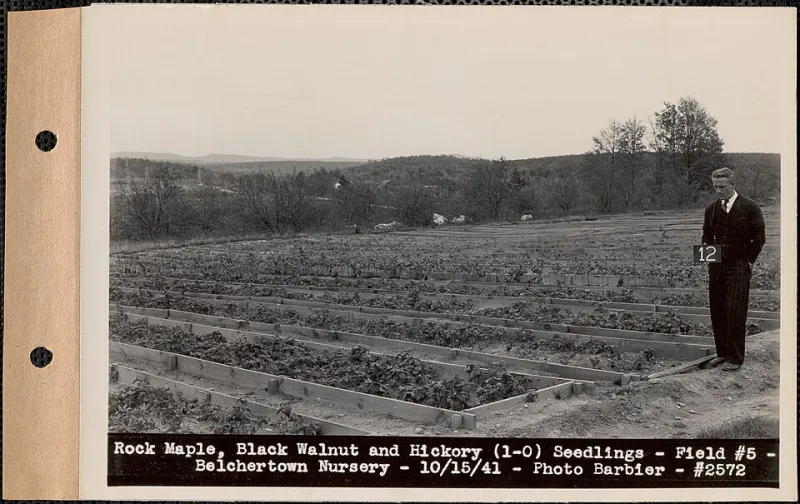
Photo: Massachusetts. Metropolitan District Water Supply Commission, Barbier, Ernest E., 1912-2007, Public domain, via Wikimedia Commons
There are no invoices. No shipping records. No co-op ledgers or USDA reports. If you go looking for documentation of the decentralized nut economy that helped feed rural and immigrant America through the Depression years, you'll find almost nothing — because the people running it never thought of it as an economy. It was just what you did in October.
You gathered what the trees gave you. You cracked it, dried it, traded it, sold it by the pound at the general store or out of the back of a truck. And when times got bad enough, you ate it — because black walnut and hickory nut contain more protein per ounce than most people's dinner.
This is the story of a food system that functioned without ever being designed, and disappeared without ever being properly mourned.
What the Trees Were Doing While Nobody Was Watching
Eastern North America is, by any reasonable measure, a nut-producing paradise. Black walnut trees grow wild from the Great Plains to the Atlantic seaboard. Shagbark hickory produces a nut so rich and sweet it was once called "the American pecan." The American chestnut, before the blight of 1904 began its devastating sweep through eastern forests, was so abundant that farmers described the autumn ground as carpeted in nuts — an almost unimaginable protein windfall that cost nothing to harvest.
Indigenous communities had built nutritional strategies around these trees for millennia. Hickory nut oil, rendered by boiling cracked nuts in water and skimming the fat, was a calorie-dense cooking medium used across the Southeast. Black walnut was ground into flour, pressed for oil, and dried for winter stores. The chestnut, before it was gone, was roasted, dried, and ground into meal that substituted for grain in lean seasons.
European settlers learned some of this and layered their own traditions on top. German, Polish, and Italian immigrant communities arriving in the Midwest and Appalachian regions brought a cultural familiarity with nut-gathering that mapped neatly onto the American landscape. They knew what to do with a hickory nut because they'd grown up doing something similar with hazelnuts and walnuts back home.
The Informal Economy That Fed People Anyway
By the early 20th century, and especially during the Depression, nut-gathering had evolved into something that looked almost like an informal trade network — if you squinted hard enough.
Families in the Ozarks, the Ohio River Valley, and the Appalachian foothills gathered black walnuts in quantities that went well beyond personal use. Hulling them was brutal, staining work — the outer husk releases a chemical called juglone that dyes skin and clothes a deep, stubborn brown — but the nuts inside were worth it. Local buyers, often connected to candy manufacturers or bakers in larger cities, would pay cash by the pound for shelled black walnut meat. For families with no other income, that cash mattered.
Hickory nuts operated on a more purely local scale. They were harder to crack and less commercially viable, which meant they stayed closer to home — traded between neighbors, used in household baking, pressed for oil by those who knew the technique. The flavor was extraordinary. People who grew up eating hickory nut cake or hickory nut pie describe it as something between a pecan and a butter toffee, with a depth that commercial nuts simply don't replicate.
And then there were the chestnuts — or rather, there weren't, not anymore. The blight that arrived on imported Asian chestnut trees in 1904 spread through eastern forests with horrifying speed, killing an estimated four billion American chestnut trees over the next four decades. An entire layer of the eastern food system simply ceased to exist. The communities that had depended on it adapted, but they didn't forget.
Why It Disappeared Without a Fight
The postwar economic boom did to backyard nut culture what it did to a lot of things: it made it seem unnecessary. Cheap protein was now available at the grocery store in tidy packages. Suburban development was converting woodlots and fence-row trees into cul-de-sacs. The children of nut-gathering families were moving to cities and working office jobs, and nobody was stopping them to say, wait, let me show you how to hull a black walnut before you go.
The knowledge didn't transfer because the conditions that made it urgent had changed. And unlike canning or bread-baking, nut processing was tied to specific trees in specific places — it couldn't be practiced in an apartment, and it couldn't be learned from a recipe card alone. You needed the land, the trees, and someone who remembered.
The commercial black walnut industry did survive in a modest form, centered largely in Missouri, where the Hammons Products Company became the dominant buyer and processor of wild-harvested black walnuts. But that's a commodity relationship, not a food culture. The knowledge of how to use the whole nut — the oil, the hull, the shell — mostly slipped away.
The Foragers Trying to Piece It Back Together
Walk into any serious foraging community today and nuts come up fast. Black walnut is having a genuine moment among wild food enthusiasts who are rediscovering its intensity — it's not subtle, and it's not trying to be. Hickory nut oil has attracted the attention of chefs who've tasted it and immediately understood what all the fuss was once about. And the American Chestnut Foundation has spent decades on a breeding program designed to restore blight-resistant chestnuts to eastern forests, with small orchards now producing nuts that are reaching farmers markets and specialty buyers.
None of this is happening fast, and none of it has yet reached the scale that would make it a real food system again. But the underlying logic — that the trees were already there, already producing, and the knowledge to use them was once widely held — hasn't changed.
Somebody's grandparents knew how to do this. A few of their grandchildren are trying to learn it again, one cracked shell at a time.