The Humble Wooden Spoon Is Smarter Than Your Silicone Spatula — and a Few People Are Trying to Prove It
The Tool That Predates Civilization (And Still Works Better)
Before there were nonstick pans, before there was stainless steel, before there was silicone in seventeen colors — there was a person with a piece of wood and something to eat. The carved wooden spoon is probably the oldest specialized kitchen tool in human history. And for most of that history, making one was a skill, a trade, and in parts of rural America, a livelihood.
That world is almost entirely gone now. But not quite.
A Trade That Ran Deeper Than Anyone Remembers
In the late 1800s and early 1900s, hand-carved wooden kitchen tools were a legitimate cottage industry across several American regions. In Appalachia, particularly in western North Carolina and eastern Tennessee, families supplemented farming income by carving spoons, spatulas, ladles, and stirring paddles from locally harvested wood — cherry, walnut, maple, and a dozen other species — and selling them through general stores, at market days, and to traveling merchants.
The Upper Midwest had its own version of the same economy, fed partly by Scandinavian and Finnish immigrant communities who brought strong carving traditions with them from Northern Europe. In Minnesota and Wisconsin, wooden tool-making wasn't just practical — it carried cultural weight, connected to a broader tradition of slöjd, the Scandinavian philosophy of craft as education and self-sufficiency.
These weren't crude objects. The best carvers understood which wood species resisted bacterial growth, which grain patterns gave a spoon structural strength at the bowl's thin edge, which handle angles reduced wrist fatigue during long stirring sessions. This was accumulated knowledge, passed down through apprenticeship and practice, refined across generations.
What Killed It
The answer is boring and familiar: industrial manufacturing. By the 1950s, stamped aluminum and then injection-molded plastic could produce a kitchen spoon for a fraction of a cent in materials and sell it for a fraction of what a carved wooden one cost. The mass-market version wasn't better. It was just cheaper, and cheaper won.
The craft didn't vanish overnight. It lingered in craft fairs and folk art contexts, increasingly understood as decoration rather than function. The knowledge of why certain woods worked better than others, how to read grain to predict where a spoon would crack, which handle profiles fit different hand sizes — that functional knowledge got separated from the objects themselves. The spoon survived as an aesthetic artifact. The expertise behind it mostly didn't.
The Ergonomic Argument Nobody Expected
Here's where it gets genuinely interesting, and where modern artisans are making a case that goes beyond nostalgia.
A hand-carved wooden spoon is almost never symmetrical in the way a factory spoon is. The bowl is slightly irregular. The handle has a subtle taper that matches the carver's sense of how a hand actually closes. The transition from handle to bowl follows a curve that industrial tooling struggles to replicate efficiently. And it turns out these "imperfections" are part of why well-made wooden tools feel different in the hand — because they were shaped around human grip geometry rather than manufacturing convenience.
There's also the heat question. Wood is a poor conductor of heat, which means a wooden spoon handle stays cool in a way that metal and even some silicone tools don't. More practically: wood doesn't scratch nonstick or enameled surfaces, doesn't react with acidic foods, and doesn't leach microplastics into your soup the way certain synthetic tools have been shown to do under heat.
A 2023 study out of a European materials science lab found that some plastic kitchen utensils release millions of microplastic particles into food during normal cooking use. Researchers have been raising flags about this for several years. The wooden spoon crowd has been quietly vindicated.
The People Trying to Save What's Left
Across the country, a loose community of wood carvers has been working to revive not just the objects but the knowledge system behind them. They teach workshops in community centers and at folk schools like the John C. Campbell Folk School in North Carolina, one of the oldest craft education institutions in America. They document traditional forms through photography and measurement before the last people who learned them the old way are gone.
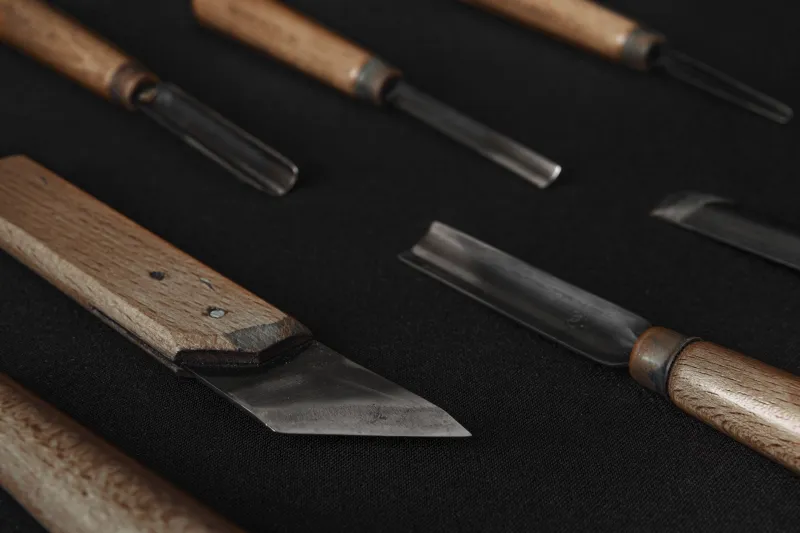
What they describe, almost universally, is the challenge of recovering knowledge that was never written down. The best carvers learned by watching and doing, not by reading instructions. The understanding of how a particular piece of cherry wood will respond to a hook knife — when to go with the grain, when to cut across it, how to read the color change that signals you're approaching the right wall thickness — that's embodied knowledge. It lives in hands and eyes, not in books.
Some of them are working with food scientists and material researchers to formally document what traditional carvers knew intuitively about wood species and food safety. The goal is to build an evidence base that supports the craft's revival on functional grounds, not just cultural ones.
Why It Matters Beyond the Kitchen
There's a broader argument hiding inside the wooden spoon story. Every time a craft like this disappears, it takes with it a specific kind of intelligence — the accumulated problem-solving of people who worked with their hands, daily, for generations, refining their tools to match the actual demands of actual cooking.
That intelligence doesn't automatically transfer to the factory floor. And when the factory eventually produces something that turns out to be inferior in ways we didn't anticipate — like, say, a spatula that sheds plastic into your scrambled eggs — there's no longer a living tradition to return to.
The spoon carvers working today are doing something more than keeping a pretty craft alive. They're keeping a knowledge system on life support until the rest of us figure out we might need it.
Your kitchen drawer probably has three or four plastic spoons in it right now. One of them is almost certainly starting to flake. Just something to think about.