One County in Pennsylvania Grows Most of America's Mushrooms — and It Almost Stayed That Way Forever

Photo: Publix Welfare Pictures Corporation (U.S. Distributor), Public domain, via Wikimedia Commons
One County in Pennsylvania Grows Most of America's Mushrooms — and It Almost Stayed That Way Forever
There's a stretch of Chester County, Pennsylvania, roughly thirty miles southwest of Philadelphia, that smells different from the surrounding farmland. It's not unpleasant — earthy, deep, faintly mineral — but it's distinctive. That smell comes from the mushroom houses: long, low-slung structures that dot the landscape around the town of Kennett Square, which has called itself the Mushroom Capital of the World since the 1920s and has the production numbers to back it up.
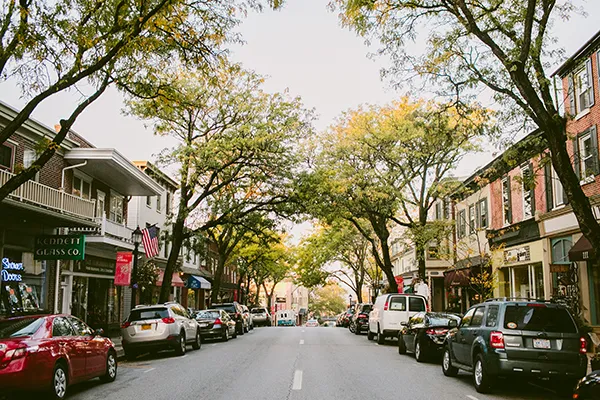 Photo: Kennett Square, via www.phoenixvillefoundry.org
What happened in Chester County over the past 130 years is one of the stranger stories in American food history — a tale of accidental discovery, industrial consolidation, and a narrowing of culinary possibility so gradual that most Americans never noticed it happening.
The Accident That Started Everything
The origin story involves carnations, which is not the beginning you'd expect. In the 1880s, a Quaker farmer named William Swayne was growing carnations in greenhouses outside Kennett Square. Greenhouse space was expensive, and Swayne was looking for a way to use the space beneath the raised flower beds — space that was dark, humid, and otherwise wasted.
 Photo: William Swayne, via artlogic-res.cloudinary.com
Somebody — accounts differ on exactly who — suggested mushrooms. The conditions under the carnation benches turned out to be nearly perfect for cultivating the white button mushroom, Agaricus bisporus, which had been grown in France since the 17th century but had never found a commercial foothold in the United States. Swayne's experiment worked. Word spread to neighboring farms. By the turn of the century, Chester County had dozens of mushroom operations, and by the mid-20th century, the region was producing somewhere between 50 and 65 percent of all commercially grown mushrooms in the country.
The soil composition helped. So did the local climate. But the real advantage was accumulated knowledge — generations of growers who understood the specific microclimates, composting techniques, and spawn management practices that made Chester County's mushroom houses unusually productive. That knowledge passed from farm to farm the way agricultural expertise always does in tight-knit communities: through observation, conversation, and occasional heated disagreement.
The Button Mushroom Monoculture
Here's where the story takes a turn. The same efficiency that made Chester County a commercial powerhouse also had a homogenizing effect on what Americans thought mushrooms were.
The white button mushroom — and its slightly more mature form, the cremini, and its fully grown version, the portobello, all of which are technically the same species at different stages — was chosen for commercial cultivation because it shipped well, bruised less visibly than other varieties, had a mild flavor that didn't challenge consumers, and could be grown in controlled indoor environments year-round. These are all legitimate commercial virtues. They are not, however, the same as being the most interesting or nutritionally complex mushroom available.
Before commercial cultivation standardized the American mushroom supply, regional wild foraging had given different parts of the country access to genuinely diverse fungal ecosystems. Morel hunters in the Midwest were pulling up Morchella species every spring. Chanterelles grew in the Pacific Northwest in quantities that felt inexhaustible. Hen of the woods, maitake, chicken of the woods, lion's mane — these were known and eaten by foragers, by immigrant communities who recognized them from their home countries, and by rural Americans who simply knew their local woods.
The rise of supermarket distribution, built around the refrigerated transport and standardized sizing that button mushrooms accommodated perfectly, didn't eliminate these varieties. It just made them invisible to most shoppers. If it wasn't in the produce aisle in a plastic tray, it didn't exist in the commercial imagination.
The Flavor We Traded Away
This matters more than it might seem. Mushrooms are one of the richest natural sources of umami — the savory, depth-of-flavor quality that makes food satisfying in a way that's hard to articulate but immediately noticeable. Different mushroom species deliver that umami in dramatically different ways. A chanterelle has a fruity, almost apricot-adjacent aroma alongside its earthiness. A lion's mane has a texture uncannily similar to crab or lobster, which is why it's become a popular meat substitute. Maitake has a layered, almost smoky complexity that the white button mushroom simply doesn't possess.
For roughly a century, American home cooking operated with access to essentially one mushroom, occasionally supplemented by canned versions of the same thing. The flavor ceiling was set artificially low, not because Americans didn't have sophisticated palates, but because the distribution system never offered them a real choice.
Chef and food writer Eugenia Bone, who has written extensively about mushroom foraging, has noted that the American relationship with wild fungi is strikingly impoverished compared to European and Asian food cultures, where mushroom diversity is taken for granted. The reason isn't geographic — North America has extraordinary fungal biodiversity. The reason is commercial.
The Correction That's Already Happening
Walk through a farmers market in any mid-sized American city today and you'll find something that would have looked exotic fifteen years ago: tables covered in oyster mushrooms, shiitakes, lion's mane clusters, king trumpets, and occasionally morels or chanterelles. Specialty mushroom farms — many of them small operations growing on logs or supplemented sawdust blocks — have multiplied rapidly across the country. The foraging community, once a niche of dedicated enthusiasts, has expanded dramatically, fueled in part by social media and in part by a genuine hunger for food that tastes like something.
Chester County's mushroom industry has adapted, too. Some growers have diversified into specialty varieties to meet demand that didn't exist a decade ago. The region that built its identity on one variety is quietly becoming something more interesting.
What's happening now isn't a trend in the way that, say, cronuts were a trend. It's more like a correction — a gradual return to fungal diversity that existed before industrial distribution decided what Americans were allowed to eat. The mushrooms were always out there. The knowledge was always there, held by foragers and immigrant communities and rural old-timers who never stopped paying attention to the woods.
It just took a while for the rest of the country to catch up.