God's Fish and Lye Water: The Gelatinous Dish That Held the Scandinavian Midwest Together
God's Fish and Lye Water: The Gelatinous Dish That Held the Scandinavian Midwest Together
There's a running joke in Minnesota that lutefisk is the only food that doubles as a paint stripper. The silverware turns black. The smell clings to curtains for days. And yet, every holiday season, thousands of people line up at Lutheran church suppers from Duluth to Fargo to eat a quivering slab of lye-treated dried cod with a smile on their face. That's not stubbornness. That's something deeper.
To understand lutefisk, you have to go back way before Minnesota existed.
Born Out of Necessity, Not Appetite
Somewhere around the Viking Age, Scandinavian fishermen figured out that Atlantic cod — abundant, firm, and oily enough to hold up — could be dried in the open air until it turned hard as a plank. This wasn't a culinary choice so much as a survival one. Dried stockfish could last for years without refrigeration, which made it invaluable across the long, brutal Norwegian winters and on sea voyages where fresh food was a fantasy.
The lye step came later, probably by accident. Dried stockfish rehydrates naturally in cold water, but soaking it in a solution of water and lye — made from wood ash — speeds the process dramatically and transforms the texture from rubbery to something almost custard-like. Food historians debate exactly when this became intentional, but by the medieval period, lye-treated fish was a staple in Scandinavian Catholic communities during Lent, when meat was forbidden. The dish even picked up a Latin name: piscis luteus, loosely meaning "yellow fish," which some linguists trace as the root of the modern word lutefisk.
By the time Norwegian and Swedish immigrants began flooding into the upper Midwest in the mid-1800s — drawn by the Homestead Act and the promise of farmland that looked, in some lights, a little like home — lutefisk came with them. Not as a delicacy. As a memory.
The Church Basement and the Community Bond
What's easy to miss, looking at lutefisk from the outside, is that it was never really about the fish. It was about the ritual.
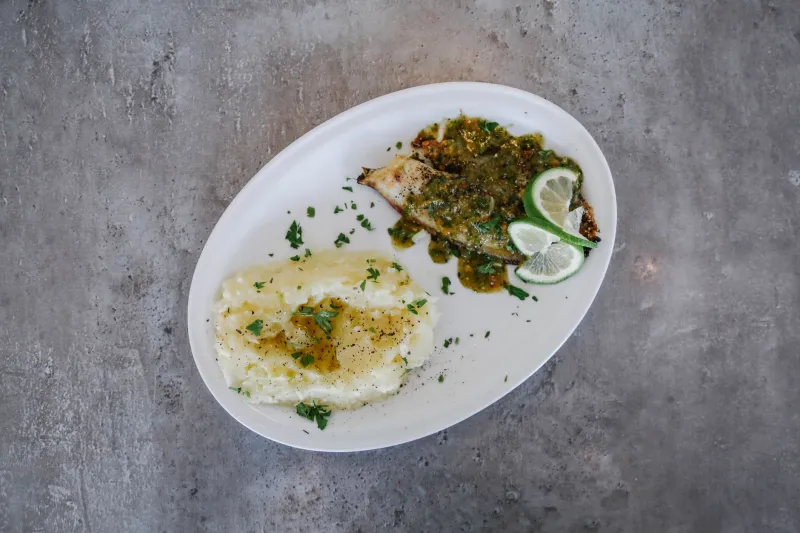
Norwegian immigrant communities in Minnesota, Wisconsin, Iowa, and the Dakotas built their social lives around Lutheran churches, and those churches built their calendars around food. The lutefisk supper — typically held in late November or early December — was one of the biggest events of the year. Women organized the preparation weeks in advance. Dried cod was ordered in bulk, soaked in lye, rinsed for days, and finally boiled or baked and served with butter, white sauce, and boiled potatoes. Hundreds of people would show up. Pews were moved. Tables were hauled out. The whole thing smelled like a fishing dock had moved into the building.
For first- and second-generation immigrants, that smell was home. It was a sensory bridge to grandparents they'd left behind in Bergen or Trondheim. For the kids who grew up eating it, it became the flavor of Christmas, of community, of belonging somewhere.
By the early twentieth century, some Minnesota towns were consuming more lutefisk per capita than anywhere in Norway itself. The fish had, in a strange way, become more Norwegian in America than it was back in Norway.
The Near-Death of a Tradition
By the 1970s, lutefisk was in trouble. The generation that had carried the tradition from the old country was aging out, and their grandchildren — fully assimilated, eating TV dinners and going to McDonald's — weren't exactly clamoring to continue the lye-fish ritual. Church memberships dropped. Supper attendance thinned. The cod importers who had supplied Midwest Scandinavian communities for decades started scaling back.
There was also the simple fact that lutefisk is, by almost any objective measure, a challenging food. The texture is gelatinous and slippery. The flavor is mild to the point of near-absence, which somehow makes the smell more confusing. Even people who grew up eating it will admit it's an acquired taste — or more accurately, an acquired context. Without the church basement, the accordion music, and the aunts in aprons, the dish loses most of its power.
For a while, it seemed like lutefisk might follow the path of so many immigrant food traditions: remembered fondly, practiced rarely, and eventually lost entirely.
The Stubborn Revival
And then something unexpected happened. It didn't disappear. It dug in.
Madison, Minnesota — population around 1,700 — declared itself the Lutefisk Capital of the World and has hosted an annual lutefisk eating contest for decades. The Sons of Norway lodges scattered across the upper Midwest quietly kept their supper traditions alive, drawing not just elderly Norwegian-Americans but younger attendees curious about heritage food. Food writers started paying attention. A handful of chefs in Minneapolis and Milwaukee began experimenting with lutefisk preparations that moved beyond the boiled-with-butter standard — pairing it with dill cream, serving it on flatbread, treating it with the same reverence a French chef might give salt cod.
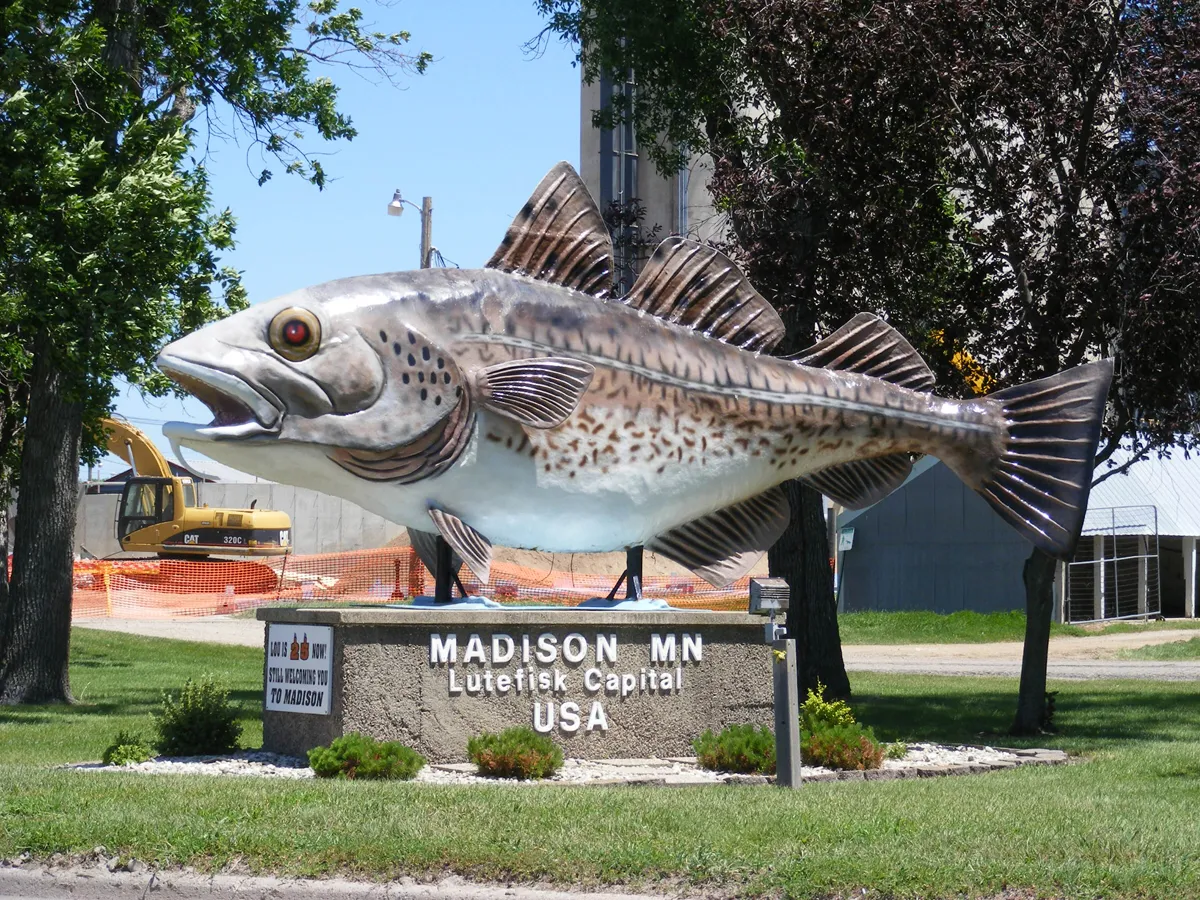 Photo: Madison, Minnesota, via lakesnwoods.com
More interestingly, the dish has attracted a kind of ironic-turned-genuine following among people with no Scandinavian ancestry at all. There's something about eating something this strange, this historically loaded, this defiantly uncommercial that appeals to a certain type of curious eater. Lutefisk is the anti-trend food. It doesn't care if you like it.
The lye-cured cod suppliers that survived the lean years are still taking orders every fall, shipping to church basements and private homes across the Midwest. The tradition is smaller than it was in 1955, but it's not gone.
Why a Wobbly Fish Still Matters
Lutefisk isn't coming for your holiday table anytime soon. It's not going to show up on a fast-casual menu or get a celebrity chef makeover that lands it on a Netflix food show. And honestly, that's fine. Some food traditions derive their entire meaning from being specific, local, and a little hard to love.
What lutefisk actually represents is something food historians call edible memory — the way certain dishes carry an entire world inside them. The Norwegian fishermen who developed this preservation method weren't thinking about identity or heritage. They were thinking about surviving winter. But the immigrants who carried the recipe across an ocean and into the frozen Midwest turned survival food into something sacred.
Next time you drive through a small town in Minnesota in December and see a hand-painted sign outside a Lutheran church advertising a lutefisk supper, consider stopping. The fish might challenge you. The smell almost certainly will. But the story behind every plate is one of the more remarkable culinary journeys in American history — and it's still being told, one wobbly serving at a time.