Prairie Kimchi: The German Settlers Who Invented Korean Fermentation Without Ever Leaving Kansas
When Winter Lasted Eight Months
Picture this: It's 1885, you're three days' ride from the nearest town, and winter on the Nebraska prairie stretches endlessly ahead. Your root cellar holds turnips, cabbage, and carrots — but no icehouse, no general store, and definitely no canned goods from back East. What do you do when fresh food means the difference between thriving and merely surviving?
If you were Greta Hoffmann, a German immigrant who'd claimed 160 acres near what would become Kearney, you'd do what seemed obvious: pack those vegetables in salt, weight them down in your grandmother's earthenware crock, and hope for the best.
 Photo: Greta Hoffmann, via atruvia.scene7.com
What Greta didn't know was that she was about to reinvent kimchi.
The Accidental Discovery
Across the Great Plains, thousands of families were facing the same problem. The Homestead Act had drawn waves of German, Scandinavian, and Eastern European settlers to a landscape that offered abundant land but brutal winters and complete isolation from familiar food systems.
These weren't experienced farmers — many were craftsmen, clerks, or laborers from crowded European cities. But they carried something valuable: half-remembered techniques from grandmothers who'd lived through famines, wars, and long winters without modern preservation methods.
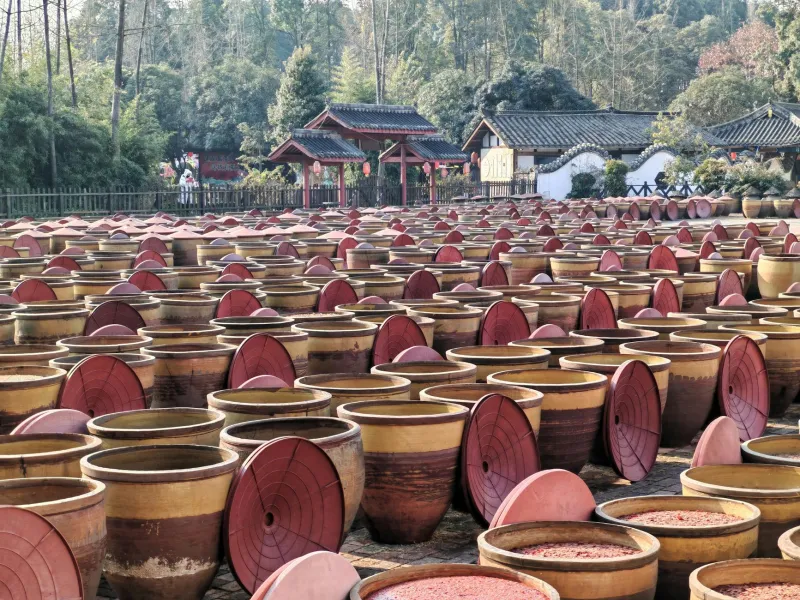
The process was surprisingly consistent across different communities. Families would shred cabbage and root vegetables, layer them with coarse salt in heavy ceramic crocks, then weigh everything down with clean stones or wooden boards. The vegetables would sit in cool cellars or dugouts, slowly transforming over weeks and months.
What emerged was tangy, complex, and absolutely nothing like the limp sauerkraut most Americans know today.
The Science Nobody Understood
Modern food scientists are fascinated by what these prairie settlers achieved without understanding the microbiology behind it. The process they stumbled onto — lacto-fermentation — is identical to the foundation of Korean kimchi, Japanese tsukemono, and dozens of other traditional fermented foods.
The salt draws moisture from the vegetables, creating an anaerobic environment where beneficial Lactobacillus bacteria thrive while harmful microorganisms can't survive. The result is food that's not only preserved but actually more nutritious than when it started, packed with probiotics, enzymes, and enhanced vitamins.
"They were creating some of the most sophisticated fermented foods in North America," explains Dr. Sarah Chen, a food historian at the University of Nebraska. "These weren't simple pickles — the flavor profiles were incredibly complex, with the same funky, umami-rich characteristics you find in the best Korean ferments."
 Photo: University of Nebraska, via cdn.vox-cdn.com
Beyond Basic Sauerkraut
The prairie ferments went far beyond simple cabbage. Families experimented with whatever vegetables they could grow or forage: turnips, beets, onions, wild garlic, even prairie grasses and roots. Some added caraway seeds, others used wild berries for sweetness and additional fermentation.
The Andersen family near Omaha became locally famous for their fermented rutabaga that developed an almost cheese-like complexity after six months in the crock. The Kowalski homestead in Kansas created a mixed ferment of cabbage, wild onions, and foraged lamb's quarters that neighbors would trade for like currency.
These weren't desperate survival foods — they were genuinely delicious, sought-after dishes that families took pride in perfecting.
The Lost Tradition
So what happened to this remarkable food culture? The same forces that transformed most of American agriculture: refrigeration, transportation networks, and industrial food production.
As railroad lines reached deeper into prairie communities, families gained access to canned goods, fresh produce shipped from distant farms, and eventually electric refrigeration. The laborious process of fermenting vegetables for winter survival became unnecessary.
By the 1940s, most families had abandoned their fermentation crocks for modern convenience. The knowledge passed down through generations was quietly set aside, then forgotten entirely.
The Modern Revival
Today, as Americans rediscover fermentation through Korean restaurants, kombucha bars, and artisanal pickle makers, food historians are racing to document what prairie families once knew by necessity.
A few stubborn practitioners never stopped. Martha Svoboda, now 89, still maintains her great-grandmother's fermentation traditions on a farm outside Grand Island, Nebraska. Her cellar holds the same German earthenware crocks that arrived by wagon train in 1883.
 Photo: Martha Svoboda, via cdn4.vectorstock.com
"People think this is some new health food trend," she laughs, pulling a jar of ruby-red fermented beets from her cellar. "My family's been eating this for 140 years. We just never called it fancy names."
Lessons From the Prairie
The parallel evolution of fermentation techniques across isolated cultures suggests something profound about human ingenuity and necessity. Given the same constraints — limited food, harsh winters, no refrigeration — communities separated by continents and centuries arrived at nearly identical solutions.
For modern cooks interested in fermentation, the prairie tradition offers lessons that Korean cookbooks often skip: how to work with whatever vegetables are available, how to adapt techniques to local climates, and how fermentation can be a practical preservation method rather than just a culinary trend.
The next time you see a $12 jar of artisanal fermented vegetables at the farmers market, remember Greta Hoffmann and thousands like her, who figured out the same techniques with nothing but necessity, salt, and whatever grew in the unforgiving prairie soil.
Sometimes the most remarkable innovations happen when no one's watching — and sometimes the best discoveries are the ones we make twice.